Showing posts with label manhasset. Show all posts

Thursday, May 10, 2018

Wall Phones, Long Cords, and Party Lines


from:  Manhasset Stories, Vol 2. 2012

The telephone number of my youth was Manhasset 7-5151. 

Area codes didn’t arrive until the mid-60s. Most people only had one line before that, and possibly, a telephone on each floor of their homes.

We had a wall-phone in the finished basement, another on a wall in the kitchen and a third - a black, desk phone - in my parents’ bedroom. The kids weren’t really allowed to use this one. It sat on a mahogany “telephone table” that had a matching chair. Most of the homes I visited had one of these some place.

All had dial phones, of course, and dial we did.

Since there was no “call waiting,” the caller had to dial and redial, then redial, again and again, to get through to a friend with a busy signal.

I was capable of doing this hundreds of times, if the message I needed to convey to a friend was important enough, as all seemed to be.

MA 7-2268.  MA 7-2268. MA 7- 2268. Endlessly my index finger turned that dial.
The girls in that house never got off the phone.

The same was true of my beloved friend, MA 7-4408,  who had three sisters. It was virtually impossible to get through to her, and if one of her older sisters answered, she was likely to say my friend wasn’t allowed to come to the phone.

The father of these four beauties finally succumbed to installing a telephone, with a separate number just for the girls, on the landing at the head of the stairs. He often said the plastic handle was going to wear out in record time because the phone was in perpetual use.

Just as a case in point, in most Baby Boomer homes the telephone was a family item, used in a communal space.

“Don’t you whisper into that phone!” was a common remark cast toward a kid whose phone cord couldn’t be stretched far enough away from an adult.

I resorted to speaking “Double G” with my friends when on the phone in the presence of authority.

I had trouble passing French quizzes, but I knew this language by heart. 

“Whitta-gut ditta-gid yitta-goo gitta-get kitta-galled titta-goo thiitta-ghee itta-goff-itta-giss fitta-gor?” I’d say into the receiver in a clear voice.

This drove my mother insane.

So my 1959 Christmas list included Ma Bell’s new “Princess Phone” for Santa to install in the room my sister and I shared. 

“It’s little...it’s lovely...it lights.” 

Marketed as a bedroom phone, the sleek design allowed it to be placed easily on a nightstand, and it came in pink.

The Princess didn’t appear under our tree, but MA 7- 0146 got one and there was truly nothing like it. I started going to her house just to have the Princess Phone experience.

Back at my house, the favored phone was outside the basement laundry room near our 
brand-new Magnavox TV.  The phone had a long cord, so even if people were watching television, I could snake into the adjacent laundry room to have some privacy.

Sometimes, I could even close the door.

I needed to be alone because my friends and I had discovered, at the age of 12, “party lines.”

I’m sure there was more to the party than the game we created on these open lines which delivered constant static when we connected to them. Somehow, we avoided the complication because we had our own agenda.

Kids hollered over the noise to each other.  

It was like getting in touch with another planet. You’d hear people shouting phone numbers over and over. Then they’d hang up to see who’d call them.

My friends and I quickly realized we could scream anyone’s phone number into that static. 

So we did.

We repeated the numbers of the St. Mary’s convent and Church rectory which we already knew by heart from all the prank calls we’d dialed their way (no *69 then).

“Is your refrigerator running, Sister?”  Ha- ha.

Can kids perform prank calls these days?  I’m not sure.

What a shame. There’s nothing like a harmless prank call that works.

Like calling a number and telling the person you’re from the telephone company and men are working on some extremely important lines close by, so please don’t answer the phone if it rings within the next two minutes. “It’s not likely,” we’d instruct authoritatively, “but picking up the phone could cause an electrocution.” 

So at 1minute 55 seconds we’d call back. We’d let the phone ring and ring. The homeowner wouldn’t pick up. Then at 2:01 we’d call again, the phone would be answered and we’d let out a blood curdling scream.

Ahhhhh.  Good times.

In high school my outgoing calls from home were to girls, mostly. It was a day and age when girls didn’t call boys.

Girls waited by the phone for boys to call us.  It was grueling. I waited often.

We only called a boy to see if his line was busy which might explain why he wasn’t calling us. But a perpetually busy line meant so many things: was a female on the phone in his house, or was he on the phone with MA7 - 2259?.

There was another important rule to this phone etiquette: If the boy’s phone rang and someone answered, we’d hang up.

Since I had an older brother, I knew first-hand how this drove parents crazy.

We’d hear our mother speaking into a void: “Hello...Hello? Oh, not this again. Please either stop calling or speak up...”

The phone was as central to our existence then as it is to teens today; but the phones we used were installed in the walls and the numbers we called had limited availability, imposed by humans as well as technology. 

For instance, each day I called the same circle of girlfriends the minute I got home from being with them at school. 

It was time-consuming to reach one of them 

When I got ‘a busy’ from MA 7- 2268 and MA 7 - 2259, I figured they were talking to each other. I made this deduction because MA 7 - 7132 was grounded, and I’d called MA 7 - 4408, only to be told she wasn’t allowed to come to the phone because it was “homework time.”

See, the main difference with the phones of the Baby Boomer years was, a parent could answer the phone and deliver ultimatums or pick up an extension and say: “I told you to get off the phone and come to dinner.”

I never had a friend whose parents didn’t do that.

Even MA 7- 0146‘s Princess phone and the four beauties with the private number found themselves without instruments from time to time. Their fathers, fed up with the constant jabbering, had each been known to unplug the four-pronged jack from the wall, insuring silence for awhile.

Somewhere along the line, I lost my fascination with spending time on the phone.  It may have started at 40 when I didn’t have my mom to call anymore, but it ended for sure when my sister
was no longer there to share events with.

We got rid of the landline at our house a few years ago. Only telemarketers called that number. 
So I only use my cell phone now.  

I have to say, I don’t find the architecture of my iPhone particularly comfortable for lengthy conversations, and besides, we’re still asking: “Can you hear me now?” no matter the server or instrument.

My kids tell me they use phone calls for business mostly, otherwise they text their friends.  I like texting, too, but it certainly has its limits.

I imagine we’ll all be Skyping and using Face Time more in the future, which in my case requires make up.

At that point, I’ll be longing for the days when we could pull the wall phone’s long cord into the laundry room and get a little privacy.


                                                                H

Sunday, April 8, 2018

Hail and Farewell to the Hermit of Miller Place

Hail and Farewell to the Hermit of Miller Place
By Suzanne McLain Rosenwasser
“Manhasset Stories,” Vols. 1 and 2.


One of my new-found, Facebook friends - formerly of Manhasset - shared her copy of Monsignor John K. Sharp’s autobiography, An Old Priest Remembers, with me. 

Having just reread the book, my new friend offered this sage advice:  

“Take all the time you need. There’s a lot in it.” 

No kidding. 

The Monsignor’s memoir was first published in 1977* when Sharp was 85 years old. He intended it to be a gift book for 100 of his family members and friends, both laity and clergy. However, demand required a second printing with an extended version and a larger distribution, selling at $10 per copy in 1978.

There’s no doubt Sharp’s life was an interesting one. He was born into the Victorian Era of Brooklyn in 1892, worked for a while at becoming a “captain of high finance,” and ended up as a seminarian whose self-proclaimed “most productive work” was the growth of St. Mary’s Church in Manhasset and his supervision of the 2800 students who attended the three parish schools, including the high schools which he established.

Ironically, he never wanted to be a teacher, but he was always a writer penning “ten books and countless articles...including a monumental three-volume history of the Catholic Church on Long Island” for the Diocese of Rockville Center, an enormous accomplishment on its own.

However it is the Monsignor’s memories of the Brooklyn and Long Island of his youth that are among the most informative and charming in his story. He was called “Kean” by family and friends, for his middle name which was an homage to his mother’s family. The Keans were a large tribe, who lived and vacationed well. They interacted among each generation for decades, with Sharp and other clerical relatives presiding at family weddings, ordinations, and funerals.

Reading Sharp’s story was eye-opening to the child in me who remembers having to face him after committing a few minor offenses that the nuns deemed worthy of the Monsignor’s input. Each instance involved me cutting high school - once to attend the ticker-tape parade for John Glenn with JFK through Wall Street and again, to greet The Beatles at JFK airport. ( As a side note, I came very close to Glenn and JFK, but nowhere near the Beatles).

Whatever! the teenager in my head gives in response to the Monsignor’s indictment today, but then I didn’t have the word. Monsignor Sharp grounded me, if you can believe that. Priests and doctors held sway over my widowed mom.

So, by the order of the holy church, I wasn’t allowed to attend Mission Day at school for the first offense - deemed less serious, perhaps, because JFK was Catholic.

As for idolizing infidels, I was not to be admitted into the boys’ basketball game or sock hop that weekend, a ruling Sharp dictated to my mother. She was to keep me home lest I become a “ne’er-do-well.”

Lo, these many decades since, while reading Sharp’s memoir, I took a certain glee in the spaghetti junction of ADD ramblings that pepper his paragraphs.

He was a clearly a man who kept meticulous records and frequently quotes from letters he wrote to and received from family, parishioners, and various bishops. His approach to telling his story involves the structure of these pieces of correspondence mingled with tales of the times surrounding them related in a Dickensian prose.

I can’t critique Monsignor Sharp.  It’s just not right. I will say, however, it is this very style that weighs his story down with the employment of words like ienic, panegyric,and sacerdotal, as well as obscure allusions to “Medes and the Persians” and Latin idioms: Dominus pars heredidtatis meae, (The Lord is the portion of my inheritance). 

I am unclear about the means which afforded Sharp to travel as widely and well as he did, nor about how a priest bought a house 100 feet above LI Sound upon retirement. I can only assume one’s vows about poverty in the religious life aren’t well defined, but I admit to knowing nothing about the mechanics of the priesthood at all.

The Monsignor retired in 1969, a year after the Second Vatican Council, when he began “to experience the headaches and frustrations of a pastor in the new age into which the Church was entering with the laity beginning to participate in its management and strange ideas about authority becoming prevalent.”

In his memoir, Monsignor Sharp is a vocal critic of both Vatican Councils and the Ecumenism brought to the Church into which he’d been ordained.  He expresses disdain for the change from habits to street clothes favored by the nuns and often notes his disagreement with the Second Council’s decision to require retirement for priests at age 75 - even questioning why the “carism of the papacy makes it unnecessary for its incumbent” to retire at the same age as priests.

Sharp’s later years, by his own assessment, were lonely. He wrote:  “I style myself  ‘The Hermit of MIller Place’. Often days pass in which I speak to no one; hear from no one; neither phone nor doorbell rings.”

I was unable to find the date of Sharp’s death, another lonely fact in consideration of the man’s accomplishments for the Diocese as well as for St. Mary’s.

Consequently, his advice at the book’s end haunts me: ”If you live long enough, you too will want to be wanted.” 

I’m sorry I didn’t know that the Monsignor was pining for visitors in the 70s.  I would have stopped by to tell him I hadn’t become an astronaut, a star stalker, or a ne’er-do-well. In fact, like him, I was going to be a teacher - the last thing I had ever expected myself to be - and a writer - the one thing I’d always planned on.

Now, it is only appropriate that I use the Monsignor’s Latin to pay the man his due, and so I say:  Frater Ave atque Vale, Monsignor. Hail brother and farewell.  


*published by Exposition Press, Hicksville, NY


Saturday, August 22, 2015

My 50th High School Reunion. Seriously.


My 50th high school reunion is this year. 

I'm sure everyone who utters this statement feels the same lack of belief that I do.

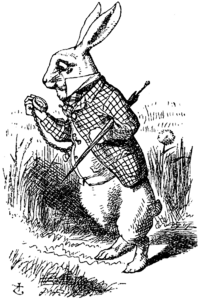
Down the Rabbit Hole.png      I remember running into a group of 50th reunion revelers when I was in college. I was with some of my Long Island high school friends in a Boston bar on  Commonwealth Avenue. We were surprised to find our hangout was filled with old people whose hangout this had been once. They sought us out, bought us drinks, and told us stories of their student days in Boston, around 1914. Fossils, right? I don't remember any of the stories, but one of the guys I was with started calling our elders "White Rabbits."

(As a refresher the reference is to Lewis Carroll who described the 
White Rabbit as "elderly, feeble, timid, and nervously shillyshallying.")

Fifty years later the White Rabbits of that evening reappear in my mind's eye, but I don't see myself or my high school friends among them - and I'm sure those White Rabbits didn't see us as we saw them.
       I wonder how 50 years will look on the expressions of my school friends when I see them - many for the first time since 1965? The classmates I've seen regularly over the years haven't aged a bit from my perspective. Oh, when I first see them coming towards me, maybe, but five minutes into a conversation and nothing has changed. We've shared youth and energy for so long - some of us since Kindergarten - that it is part of who we are when we're together.
      What amazes me is that same feeling has come through the telephone when I've talked to long-lost friends about our upcoming reunion. I don't know what they look like these days, since we're not on face-time nor are we facebook friends, so it's the voice that triggers the link. There's no "quavering," no "shilly-shallying." It's just as we always were.
    Of course, the changes show through: We aren't discriminatory about who our friends are any more. We suffer deep pauses to honor the trials of our lives. We overuse the phrase: "Remember when...." We recall that since our last reunion in 1997, dear ones have died, long marriages have ended, and a multitude of grandchildren have been born.
       But all of that fades away when we allow ourselves the luxury of settling back into the friendship and fun of high school, turning the sturm and drang of it into humor because we were teenagers then, and we also went to a Catholic school where boys and girls attended classes in separate buildings after 8th grade commencement.
      However, in our town, we are fortunate to have a unifying element: The Tender Bar, made famous in JR Moehringer's memoir of the same title. The bar, now known as Edison's, was called Gino's in our iteration of the same place. Today, the bar hosts nearly every Friday night open house for Manhasset's public and parochial school reunions. The layout is exactly the same, and if the music is right, Baby Boomers will be able to imagine "Gary and the Wombats" playing in the back room while we dance away the years into memories.
        These will comprise:
        Performing at or going to the New York World's Fair; imitating the Rolling Stones for a school review; hearing a gifted classmate sing "Let There Be Peace on Earth."
     
      There will be memories of Mission Day, when the boys got to come to the girls' school, or proms at the Garden City Hotel where nuns and brothers greeted us upon entry, or the Boulevard nightclub in Queens where Dione Warwick entertained us in the wee hours after our senior dance.
          Someone will bring up the trip to Notre Dame University; a religious retreat to eastern Long Island; basketball games followed by sock hops in the boys' gym; cross country; baseball; cheerleading; the Tumbling Team; the Magnificat; the Recordare, and the demerits we got for being "out of uniform."  Oh, and a most important fact: The 1965 Girls' School Sports' Night ended in an unprecedented Blue and White tie.
        So, for full disclosure, I wasn't going to go to this reunion until the other day when a friend since Kindergarten called and said: "How many chances are we going to get to go to a 50th reunion?"
        I realized she was right. I wasn't a huge fan of high school itself, (although I taught in the field for 25 years), but I loved the people in that little micro-cosm of life. The girl in homeroom who sat in front of me from Kindergarten through 12th grade. The boy at my first sock hop who asked me to dance. Al, the crossing guard at Northern Boulevard who joked us across the street ("Yackety-Yak"). George at Town Hall Pharmacy who made us prove we had money before letting us in the door. The parents who let us drive their convertibles under starlit skies from Shore Road to Sands Point and back again. The bouncers who let us into Gaffney's, My Father's Place, the Jaunting Car Pub, and the Scratch. The bartender in Gino's who announced my mother had just called to say: "Come home, now!"
        I've decided I want to remember these things with the Class of 1965, the kids who went off to college in full prep school dress, only to return at Christmas in blue jeans and tie-dyed shirts. The ones who went off to pursue a religious life. The ones who went off to war. The ones who became poets, parents, and professors; lawyers, sales reps, doctors, traders, realtors, and heroes. All of us. For this is a chance to look at who we were then, who we are now, and the distance in between - a view that doesn't come often in life.

*****

Also, the Friday night get-together will be November 6, 2015, beginning at 7:30 (pay as you go) at Edison’s (the old Gino’s). One of the beauties of public or private school in Manhasset is we knew each other through siblings and friends. So if you’re a sibling or friend of the Class of ’65, come to the Tender Bar on November 6th. It would be so great to see you.

***


Suzanne McLain Rosenwasser is the author of several books:


Order paperbacks or ebooks at all online sellers or click here for Amazon orders:
http://amazon.com/author/suzannerosenwasser

Visit:  http//:www.suzannerosenwasser.com


Friday, June 14, 2013

Proms, Dione Warwick, and a White '59 Corvette


File:Dionne Warwick A House.jpg        
              Corvette For Sale Photo


High School teachers attend proms. Before retirement, I had been to more than a few, and at each one - as chaperones - we gaped at the kids doing their things and told our own prom stories. 

These are mine.

St. Mary’s had a Junior Prom held in the boys’ gym when the schools were separated by gender. In my Sophomore year, a Junior invited me. My mother said I was too young to go to a prom and I’m sure I threw a huge fit, but I didn’t go.

In my Junior year, I was dating a Manhasset boy who was a Freshman in college. Since my mother knew his mother, the age difference seemed to pass by without a squabble. The college boy accepted my invitation to Junior Prom in the gym: “An Evening in Paris,” decorated by student council members.

I wore a dotted-swiss dress which came down to the floor and clear up to my neck where it was delicately embroidered with pink rosebuds. It was a hand-me-down from my sister, Mary - a normal, clothing transaction I was fine with my whole life, right up to the day I wore the same wedding gown she had worn. 

As for Junior Prom, the college boy had his own car, so - unlike most of my friends going with boys who weren’t old enough to drive at night - I didn’t have to travel in the backseat while someone’s father chauffeured us to the high school.

There was one problem, however.  My college boy was the ex-boyfriend of one of my BFF’s. She had not taken the breakup well, and when I entered the picture - even though time had passed - she couldn’t forgive me.

I totally got that. Really. I would have hated me, too. 

Consequently, since our other friends understood the issue more clearly than I did in my nubile romantic state, they supported our mutual, heartbroken girlfriend.

That left college boy and me with nowhere to sit at prom.

So we walked around to other tables, saying hello. We danced a bit to “Bobby and the Orbits.” We had our photo taken under a starry blue, eiffel-towered arch and danced some more. That’s all I remember of the night. I know at some point our romance involved the exchange of a heavy silver, I.D. bracelet, some necking at the Westbury Drive-In, and a few nights spent in Gino’s or at the Hilltop (illegally for me).

However, by the spring of my Senior year, all that had changed. College boy was gone, my BFFs were back, and I didn’t have a date for my Senior Prom at the Garden City Hotel. 

Suffice it to say, in 1965 girls didn’t go to proms in groups or pairs.

A few weeks before the big night, I was discussing this dilemma in a kitchen in Sea Cliff where a St. Mary’s friend lived with her parents and two brothers.

Her mother - one of the kindest and most beautiful moms I’ve ever known - said:  

“Well you’ve got to go to your Senior Prom!  It’s something you never forget. Why don’t you go with (not his name) Jay? Yes, that’s perfect!”

And before I knew it, she was calling: 

“Ja-ay?  Ja ayyy?” up the stairs and my friend was jumping up and down, saying: 

“Perfect.  Jay’s the perfect answer. You can go with JAY!”

I was stunned. Jay was a year older than we were and about as close to perfect as one could get.  

His brown hair stood up in a high crew; he had a “great physique” (in the term of the times) and his eyes - well, let’s just say, my friends would be more than honored to sit with me this year.

Jay’s mom came bounding down the back steps - in jeans with her pony- tail bobbing and her smile pulsing all the way through her eyes over to mine.

“Jay just got out of the shower.  He’ll be down in a minute.” 

Before I had a chance to breathe in some Zen at a two-story window looking out over the cliffs onto LI Sound, Jay came down the stairs -  in a tennis shirt that hung out over cut-off jeans. He was rubbing his wet hair with a towel.

“So...Susu..how about I take you to prom?”

I started to laugh and say stupid things about his mother making him ask me - and Jay said:

“It wasn’t my mom that made me ask you, it was her promise that I could take you in her car.”

Well, that may have offended some girls, but Jay’s mom’s car was a 1959, white Corvette convertible - a two-seater with red leather seats.

I went over it in my head:  My date would be Jay - one of the smoothest St. Mary’s guys in the Class of 1964 who would be driving one of the coolest cars ever. It started to make sense to me, so I said: “Let’s go!” 

I wore a butter-yellow dress with an empire waist and soft ruffles at the neck that I’d just worn as a bridesmaid in my brother’s wedding. I also carried a light scarf, as advised by Jay’s mom, so we could ride with the top down. 

Jay wore a white dinner jacket and pinned a Gardenia corsage below my shoulder. 

When we pulled up to the front of the Garden City Hotel, three parking valets ran toward the Corvette to attend to it.

I don’t remember much of the prom itself. I mostly remember driving in that car which took us along the LIE toward Queens at midnight. We were headed to “The Boulevard,” a nightclub.  Dione Warwick was scheduled to perform at 1 a.m. after doing a few other shows first and finding the need to have more than a drink or two while she performed. The last show of her night was for an audience composed of underaged school kids with fake id’s.

I will be kind and say she was over-tired and perhaps alcohol wasn’t the best choice; she was definitely at the stage where one’s words aren’t coming together well.  So, for some reason, she stopped singing and began to tell LONG stories about herself in high school - none of which I recall - but I do remember this: She kept saying she’d cook breakfast for us if we showed up at her house in NJ. She had an assistant write out directions. She was quite insistent about making kids in the audience promise they’d show up.

I never heard about anyone going. I know the kids I was with didn’t even think about it.

We had plans back in Sea Cliff - on the beach below Jay’s parents’ house, where they and some of the other Senior parents were serving breakfast.  

We ate a fine spread and watched the sun come up over the familiar shorelines of our LI Sound. Someone played the guitar, some of us fell asleep, a few had serious conversations with the adults about what our futures held. Others went for walks down along the water.

Jay and I watched it all, and, while the sun rose just a few coves away over our hometown, friends became friends forever - and I never forgot that Jay’s mom was right about some memories living with us as long as we live.

Click here to order MANHASSET STORIES I & II from Amazon
Click here to order MANHASSET STORIES I & II from B&N  or stop by The Little Shop 'Round the Corner in Manhasset


                                                                                        BOBBY & the ORBITS