My 50th high school reunion is this year.
I'm sure everyone who utters this statement feels the same lack of belief that I do.
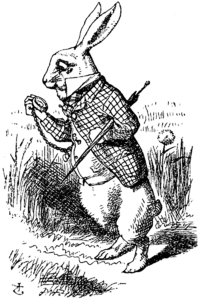 I remember running into a group of 50th reunion revelers when I was in college. I was with some of my Long Island high school friends in a Boston bar on Commonwealth Avenue. We were surprised to find our hangout was filled with old people whose hangout this had been once. They sought us out, bought us drinks, and told us stories of their student days in Boston, around 1914. Fossils, right? I don't remember any of the stories, but one of the guys I was with started calling our elders "White Rabbits."
(As a refresher the reference is to Lewis Carroll who described the
White Rabbit as "elderly, feeble, timid, and nervously shillyshallying.")
Fifty years later the White Rabbits of that evening reappear in my mind's eye, but I don't see myself or my high school friends among them - and I'm sure those White Rabbits didn't see us as we saw them.
I wonder how 50 years will look on the expressions of my school friends when I see them - many for the first time since 1965? The classmates I've seen regularly over the years haven't aged a bit from my perspective. Oh, when I first see them coming towards me, maybe, but five minutes into a conversation and nothing has changed. We've shared youth and energy for so long - some of us since Kindergarten - that it is part of who we are when we're together.
What amazes me is that same feeling has come through the telephone when I've talked to long-lost friends about our upcoming reunion. I don't know what they look like these days, since we're not on face-time nor are we facebook friends, so it's the voice that triggers the link. There's no "quavering," no "shilly-shallying." It's just as we always were.
 Of course, the changes show through: We aren't discriminatory about who our friends are any more. We suffer deep pauses to honor the trials of our lives. We overuse the phrase: "Remember when...." We recall that since our last reunion in 1997, dear ones have died, long marriages have ended, and a multitude of grandchildren have been born.
But all of that fades away when we allow ourselves the luxury of settling back into the friendship and fun of high school, turning the sturm and drang of it into humor because we were teenagers then, and we also went to a Catholic school where boys and girls attended classes in separate buildings after 8th grade commencement.
However, in our town, we are fortunate to have a unifying element: The Tender Bar, made famous in JR Moehringer's memoir of the same title. The bar, now known as Edison's, was called Gino's in our iteration of the same place. Today, the bar hosts nearly every Friday night open house for Manhasset's public and parochial school reunions. The layout is exactly the same, and if the music is right, Baby Boomers will be able to imagine "Gary and the Wombats" playing in the back room while we dance away the years into memories.
These will comprise:
Performing at or going to the New York World's Fair; imitating the Rolling Stones for a school review; hearing a gifted classmate sing "Let There Be Peace on Earth."

Someone will bring up the trip to Notre Dame University; a religious retreat to eastern Long Island; basketball games followed by sock hops in the boys' gym; cross country; baseball; cheerleading; the Tumbling Team; the Magnificat; the Recordare, and the demerits we got for being "out of uniform." Oh, and a most important fact: The 1965 Girls' School Sports' Night ended in an unprecedented Blue and White tie.
So, for full disclosure, I wasn't going to go to this reunion until the other day when a friend since Kindergarten called and said: "How many chances are we going to get to go to a 50th reunion?"
I realized she was right. I wasn't a huge fan of high school itself, (although I taught in the field for 25 years), but I loved the people in that little micro-cosm of life. The girl in homeroom who sat in front of me from Kindergarten through 12th grade. The boy at my first sock hop who asked me to dance. Al, the crossing guard at Northern Boulevard who joked us across the street ("Yackety-Yak"). George at Town Hall Pharmacy who made us prove we had money before letting us in the door. The parents who let us drive their convertibles under starlit skies from Shore Road to Sands Point and back again. The bouncers who let us into Gaffney's, My Father's Place, the Jaunting Car Pub, and the Scratch. The bartender in Gino's who announced my mother had just called to say: "Come home, now!"
I've decided I want to remember these things with the Class of 1965, the kids who went off to college in full prep school dress, only to return at Christmas in blue jeans and tie-dyed shirts. The ones who went off to pursue a religious life. The ones who went off to war. The ones who became poets, parents, and professors; lawyers, sales reps, doctors, traders, realtors, and heroes. All of us. For this is a chance to look at who we were then, who we are now, and the distance in between - a view that doesn't come often in life.
*****
Also, the Friday night
get-together will be November 6, 2015, beginning at 7:30 (pay as you go) at
Edison’s (the old Gino’s). One of the beauties of public or private school in
Manhasset is we knew each other through siblings and friends. So if you’re a
sibling or friend of the Class of ’65, come to the Tender Bar on November 6th.
It would be so great to see you.
***
Suzanne McLain Rosenwasser is the author of several books:
***
Suzanne McLain Rosenwasser is the author of several books:
 |
| Order paperbacks or ebooks at all online sellers or click here for Amazon orders: http://amazon.com/author/suzannerosenwasser Visit: http//:www.suzannerosenwasser.com |


